
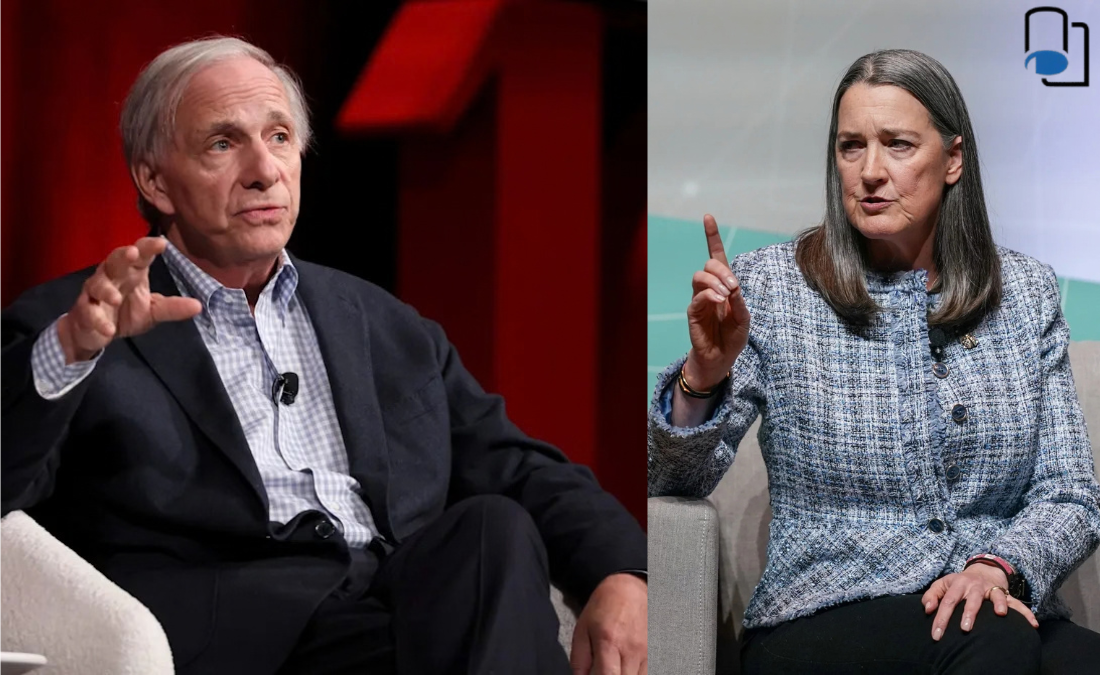

Ray Dalio and Patricia Poppe are two prominent American business leaders whose careers have developed in very different industries. Dalio is best known for founding Bridgewater Associates and developing a highly influential approach to investing, economic analysis, and organizational management. Patricia “Patti” Poppe, meanwhile, is an energy-industry executive who became CEO of PG&E Corporation and has focused much of her career on utility operations, safety, infrastructure, and customer service.
The names Ray Dalio and Patricia Poppe sometimes appear together in online searches, which can create the impression that the two have a direct personal or professional relationship. However, available reliable sources do not establish that they are relatives, business partners, colleagues, or collaborators. Their most concrete connection is institutional rather than personal: Bridgewater Associates, the investment firm Dalio founded, has reported holdings in PG&E Corporation. That fact should not be confused with evidence that Dalio personally invested in PG&E or worked directly with Poppe.
Understanding their individual careers provides a clearer picture of why these two business figures attract attention and why their names may be discussed together.
Who Is Ray Dalio?
Ray Dalio is an American investor, entrepreneur, author, and philanthropist. He founded Bridgewater Associates in 1975 from his two-bedroom apartment in New York. Over the following decades, the firm developed from a small advisory operation into one of the world’s best-known investment organizations.
According to Bridgewater’s official biography, Dalio became interested in financial markets when he was 12 years old. While working as a caddie at a golf course, he heard conversations about stocks and became fascinated by investing. He used his earnings to purchase his first stock, beginning a lifelong interest in financial markets.
Dalio attended what is now Long Island University, where he studied finance, and later earned an MBA from Harvard Business School in 1973. After working for several Wall Street firms, he established Bridgewater in 1975.
In the early years, Bridgewater focused on consulting and managing financial exposures, particularly in commodities and futures. The company also developed research that examined economic relationships and market conditions. A major milestone came in 1985, when the World Bank gave Bridgewater a $5 million account to manage.
Ray Dalio and Bridgewater Associates
Dalio’s name is closely associated with Bridgewater because he played a central role in building the firm’s investment philosophy and organizational culture.
Bridgewater became particularly known for its focus on economic cycles, systematic decision-making, diversification, and the use of explicit principles. Dalio later described many of his personal and professional lessons in his bestselling book Principles: Life & Work.
His influence extended beyond investing. He developed ideas about management, decision-making, disagreement, transparency, and learning from mistakes. His writings and interviews have made him a recognizable figure not only in finance but also in discussions about leadership and organizational culture.
However, Dalio is no longer responsible for the firm’s daily management. Bridgewater says that its multiyear transition from a founder-led organization was completed in 2022. The company transferred control to a new generation of leaders while Dalio moved away from operational leadership.
Bridgewater currently identifies Nir Bar Dea as its chief executive officer. He has served as CEO since 2022 and oversees the company’s strategic direction and day-to-day management.
This distinction is important when discussing Ray Dalio in relation to Bridgewater today. He remains the firm’s founder and an important figure in its history, but he should not be described as the current CEO running the company.
Ray Dalio’s Investment Philosophy
One of Dalio’s most recognizable contributions is his principles-based approach to investing and decision-making.
Rather than viewing individual market events in isolation, his approach has emphasized understanding how economic forces interact. Interest rates, inflation, debt, currency movements, economic growth, and investor behavior can influence financial markets in interconnected ways.
Bridgewater became particularly associated with systematic strategies designed to diversify exposure across different economic environments. Dalio’s ideas have therefore often been discussed in the context of risk management rather than simply predicting whether a particular asset will rise or fall.
His broader philosophy also places importance on identifying mistakes and learning from them. These ideas became part of his public writing and helped make Principles a widely discussed book among business readers.
Who Is Patricia Poppe?
Patricia Poppe, commonly known as Patti Poppe, is an American executive whose career has focused primarily on manufacturing and the energy sector.
She joined PG&E Corporation as CEO in January 2021. PG&E’s own materials identify her as CEO of the corporation and describe her focus on safety, operational improvement, customer needs, and the future of California’s energy system.
Poppe’s professional background differs substantially from Dalio’s. Instead of building an investment management organization, she developed experience in industrial operations and utilities.
Before joining PG&E, Poppe held leadership positions in the energy sector, including at CMS Energy and Consumers Energy. Her background also included experience at General Motors.
This operational experience became important to her approach at PG&E, where issues such as electrical infrastructure, wildfire safety, reliability, affordability, and regulatory requirements require decisions with direct physical consequences.
Patricia Poppe and PG&E
PG&E Corporation is the parent company associated with Pacific Gas and Electric Company, a major energy utility serving California.
Poppe became CEO during a particularly important period for the company. PG&E has faced significant challenges involving wildfire risk, infrastructure resilience, energy affordability, reliability, and the modernization of its system.
Under Poppe’s leadership, PG&E has emphasized safety and infrastructure improvements. The company has also promoted efforts to modernize its electrical system and increase resilience.
In a January 2026 customer letter, Poppe discussed PG&E’s priorities, including safety, family well-being, energy affordability, and efforts to reduce customer costs.
PG&E’s July 2026 sustainability reporting also identified Poppe as CEO of PG&E Corporation and described the company’s ongoing work involving safety, clean energy, reliability, infrastructure hardening, and customer affordability.
What Does “Leading With Love” Mean?
One phrase strongly associated with Poppe’s leadership at PG&E is “leading with love.”
The phrase describes a people-centered management philosophy. In her 2026 customer letter, Poppe explained it in terms of putting safety, family well-being, and energy affordability at the center of business decisions.
This represents a different vocabulary from the principles commonly associated with Ray Dalio.
Dalio’s public philosophy has emphasized principles, systematic thinking, transparency, disagreement, and learning from mistakes. Poppe has frequently emphasized people, safety, customer needs, and organizational culture.
The difference reflects the industries in which they operate.
Ray Dalio and Patricia Poppe: Is There a Direct Connection?
There is no reliable evidence establishing a direct personal or professional relationship between Ray Dalio and Patricia Poppe.
Available sources do not establish that they are:
- Business partners
- Family members
- Spouses
- Direct colleagues
- Co-founders of a company
- Participants in a documented joint project
Therefore, it would be inaccurate to present them as business partners or close professional associates without additional evidence.
The connection becomes more interesting when their organizations are considered.
The Bridgewater and PG&E Connection
Bridgewater Associates is an institutional investment manager, while PG&E Corporation is an energy company.
The U.S. Securities and Exchange Commission maintains quarterly Form 13F filings for institutional investment managers. Bridgewater Associates, LP filed a Form 13F for the quarter ending June 30, 2026. The filing identifies Bridgewater Associates, LP as the institutional investment manager submitting the report.
This type of filing reports securities held under an institutional manager’s investment discretion. It should not automatically be interpreted as a personal investment statement belonging to Ray Dalio.
Consequently, even when Bridgewater reports an investment in a company such as PG&E, that does not establish that Dalio personally purchased the shares or that he personally directed the investment.
This distinction is particularly important because Dalio completed his transition away from Bridgewater’s control in 2022.
Why Their Careers Are Often Compared
Although Dalio and Poppe have no clearly documented direct relationship, their careers can be examined side by side because both have led complex organizations.
Dalio’s professional environment is dominated by financial markets and economic uncertainty. His central questions involve investment risk, economic relationships, market behavior, and capital allocation.
Poppe’s environment is much more operational. Utility leadership involves physical infrastructure, workers, customers, safety systems, regulators, energy demand, and reliability.
Both fields involve uncertainty, but the nature of that uncertainty is different.
For an investment firm, changing interest rates or economic conditions can alter portfolio outcomes. For an energy utility, infrastructure failures, severe weather, wildfire exposure, equipment problems, and changing energy demand can affect customers and communities.
Different Approaches to Decision-Making
Dalio’s career demonstrates the use of systematic frameworks in financial decision-making. His Bridgewater philosophy was built around analyzing economic relationships and creating repeatable approaches to decision-making.
Poppe’s career illustrates a more operational approach. Her leadership at PG&E has focused on translating organizational goals into changes involving employees, infrastructure, safety, customer service, and energy technology.
Neither approach exists in isolation. Large organizations require both strategic thinking and operational execution.
Their careers therefore provide two different examples of how executives can approach complicated organizational problems.
Poppe’s Focus on Energy Innovation
Technology has also become an important part of Poppe’s work at PG&E.
In a 2024 article published by PG&E, Poppe discussed automation, predictive technologies, equipment monitoring, personalized customer experiences, and innovations intended to support a cleaner and more resilient energy system.
The company’s research and development efforts have included identifying technical challenges and working with innovators to explore solutions.
This is another important difference between Poppe’s work and Dalio’s. Dalio’s career centers on financial and economic systems, whereas Poppe’s work involves an enormous physical network that has to deliver electricity and other energy services reliably.
Why Accurate Context Matters
The phrase “Ray Dalio and Patricia Poppe” can easily encourage speculation because both are recognizable business leaders.
However, a careful examination of available evidence shows that they should primarily be understood as two separate figures.
Ray Dalio built Bridgewater Associates and became known internationally for his investment principles and ideas about management. Patricia Poppe built a career in manufacturing and energy before becoming CEO of PG&E Corporation.
The institutional overlap involving Bridgewater and PG&E is a factual area that can be researched through regulatory filings. But it should not be expanded into claims about a personal relationship without evidence.
This distinction is especially important when discussing financial holdings. A company’s regulatory filing does not necessarily reveal the personal decisions, motivations, or relationships of its founder.
Ray Dalio and Patricia Poppe in 2026
As of 2026, Dalio’s role is primarily associated with his continuing influence as the founder of Bridgewater and with his writing, investing ideas, and philanthropic activities. Bridgewater’s current management is led by a newer generation, with Nir Bar Dea serving as CEO.
Poppe remains associated with PG&E Corporation’s executive leadership. PG&E’s 2026 communications continue to identify her as CEO and highlight her focus on safety, affordability, reliability, infrastructure, and energy transformation.
Their current professional positions therefore remain distinct.
Frequently Asked Questions
1. Are Ray Dalio and Patricia Poppe related?
There is no reliable public evidence establishing that Ray Dalio and Patricia Poppe are relatives. They come from different professional backgrounds and have built careers in different industries.
2. Are Ray Dalio and Patricia Poppe business partners?
No documented business partnership between Dalio and Poppe has been established. Dalio is the founder of Bridgewater Associates, while Poppe is the CEO of PG&E Corporation. Their organizations operate in different industries.
3. What is the connection between Ray Dalio and Patricia Poppe?
The most concrete connection is institutional rather than personal. Bridgewater Associates has filed investment disclosures involving publicly traded securities, while Poppe leads PG&E Corporation. A Bridgewater investment disclosure does not establish a direct relationship between Dalio and Poppe.
4. Is Ray Dalio still the CEO of Bridgewater?
No. Dalio stepped away from Bridgewater’s executive responsibilities over several years. Bridgewater completed its transition from Dalio to the firm’s next generation of leadership in 2022. Nir Bar Dea is currently identified by Bridgewater as its CEO.
5. What is Patricia Poppe best known for?
Patricia Poppe is best known for her leadership in the energy and utility sector and for serving as CEO of PG&E Corporation. Her work has emphasized safety, operational improvement, infrastructure resilience, customer affordability, and energy innovation. PG&E continues to identify her as CEO in its 2026 corporate communications.
Conclusion
Ray Dalio and Patricia Poppe represent two very different paths through American business leadership. Dalio built Bridgewater Associates around investment research, economic analysis, systematic decision-making, and a distinctive management philosophy. Poppe developed her career through manufacturing and energy before becoming CEO of PG&E Corporation, where her responsibilities include safety, infrastructure, reliability, affordability, and the changing energy landscape.
There is no reliable evidence that the two are personally or professionally connected. The most concrete link between their professional worlds comes through their organizations: Bridgewater is an institutional investment manager, while PG&E is a major energy company led by Poppe.
Rather than treating the two names as evidence of a partnership, it is more accurate to view them as separate leadership stories that intersect indirectly through the world of corporate investment and public markets. Their careers demonstrate how leadership can take very different forms depending on the industry, responsibilities, risks, and stakeholders involved.