

Introduction
In cycle repair shops and mechanical workshops, the word “weeped” is often used in informal conversation to describe a common technical issue related to oil or fluid leakage. Although it is not a standard English word, it is widely understood in practical workshop environments.
This article explains what “weeped” means in cycle and mechanical contexts, how it is used, and what the correct technical terminology is.
1. Meaning of “Weeped”
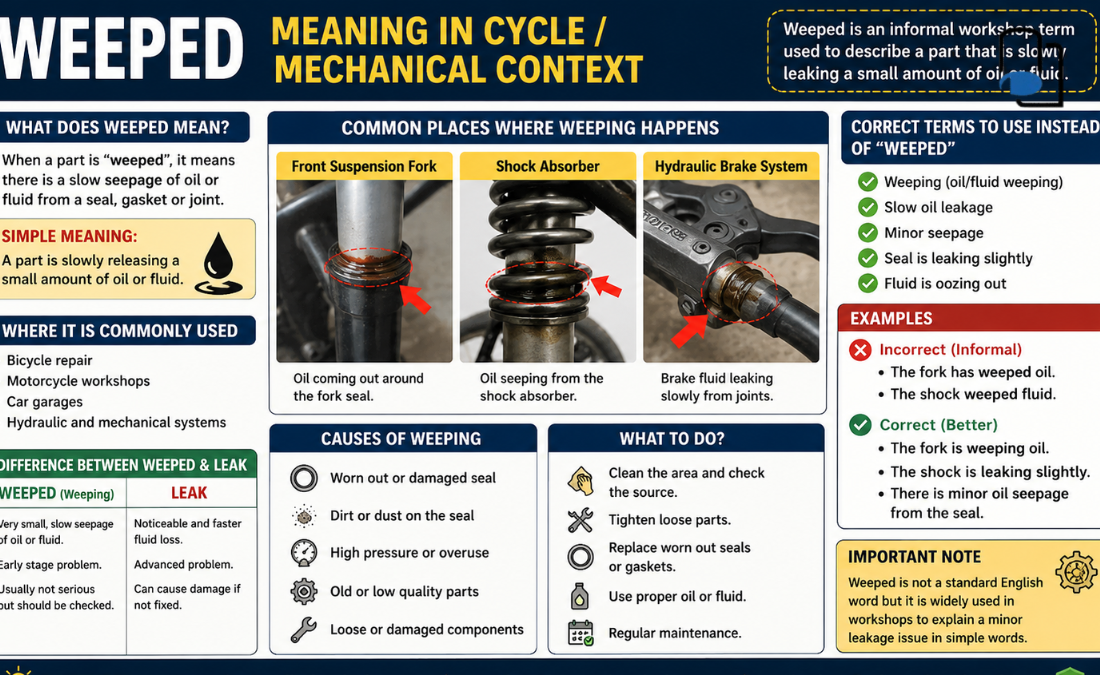
“Weeped” is an informal term used to describe a situation where a mechanical part is experiencing a slow and minor leakage of oil or fluid.
It does not refer to a major leak. Instead, it describes a small seepage or oozing of fluid from seals, joints, or gaskets.
Simple meaning: a part is slowly leaking a small amount of oil or fluid.
2. Use in Cycle and Bicycle Systems
In bicycles, the term “weeped” is commonly used when:
- The front suspension fork shows small oil traces around the seal
- The shock absorber releases slight oil over time
- Hydraulic brake components show minor fluid dampness
- Seals begin to weaken and allow slow seepage
This condition is usually an early warning sign that a seal or component may need maintenance.
3. Where the Term is Commonly Used
The word “weeped” is mainly used in informal settings such as:
- Bicycle repair workshops
- Motorcycle garages
- Automotive repair shops
- Local mechanical discussions
It is not typically used in technical manuals or professional engineering documentation.
4. Technical Explanation
In proper mechanical terminology, the condition described as “weeped” is known as:
- Minor fluid seepage
- Slow oil leakage
- Weeping condition of a seal or gasket
This occurs when a seal or gasket is no longer fully tight, allowing a small amount of fluid to escape gradually.
5. Common Areas Where Weeping Occurs
Bicycle components
- Suspension fork seals
- Rear shock absorbers
- Hydraulic brake systems
Automotive components
- Engine oil seals
- Gaskets
- Transmission seals
- Radiator joints
In all these cases, the leakage is usually small but should be monitored.
6. Why Mechanics Use the Term “Weeped”
Despite being grammatically incorrect, mechanics use the term “weeped” because:
- It is simple and widely understood in workshops
- It quickly describes minor leakage
- It is part of informal technical language passed between mechanics
- It is easier than using formal technical terms
7. Difference Between Weeping and Leakage
Weeping and leakage are often confused, but they are different in severity.
Weeping refers to a very small, slow seepage of fluid. Leakage refers to a more noticeable and continuous loss of fluid.
Weeping is usually an early stage problem, while leakage indicates a more serious issue requiring immediate repair.
8. Correct Technical Alternatives
Instead of using “weeped,” the following terms are more accurate:
- Slow oil seepage
- Minor leakage
- Seal is weeping
- Fluid is oozing slightly
- Small oil leakage
These terms are preferred in professional mechanical and engineering communication.
9. Example Usage
Incorrect:
- The bicycle fork has weeped oil
- The shock absorber weeped fluid
Correct:
- The bicycle fork is showing minor oil seepage
- The shock absorber is leaking slightly
10. Conclusion
“Weeped” is not a standard English word, but it is commonly used in informal mechanical and cycle repair language to describe slow oil or fluid leakage. The correct technical term for this condition is “weeping” or “minor seepage.”
Understanding this term helps in identifying early mechanical issues in bicycles and vehicles before they become serious problems.
FAQs
1. Is “weeped” a correct English word?
No, it is not correct in standard English.
2. What does “weeped” mean in mechanics?
It refers to a slow, minor leakage of oil or fluid.
3. Where is the term “weeped” used?
It is commonly used in bicycle and automotive workshops.
4. Is weeped a serious problem?
Not usually. It indicates a minor early-stage leakage.
5. What is the correct term instead of weeped?
Weeping, minor seepage, or slow leakage.