
Introduction
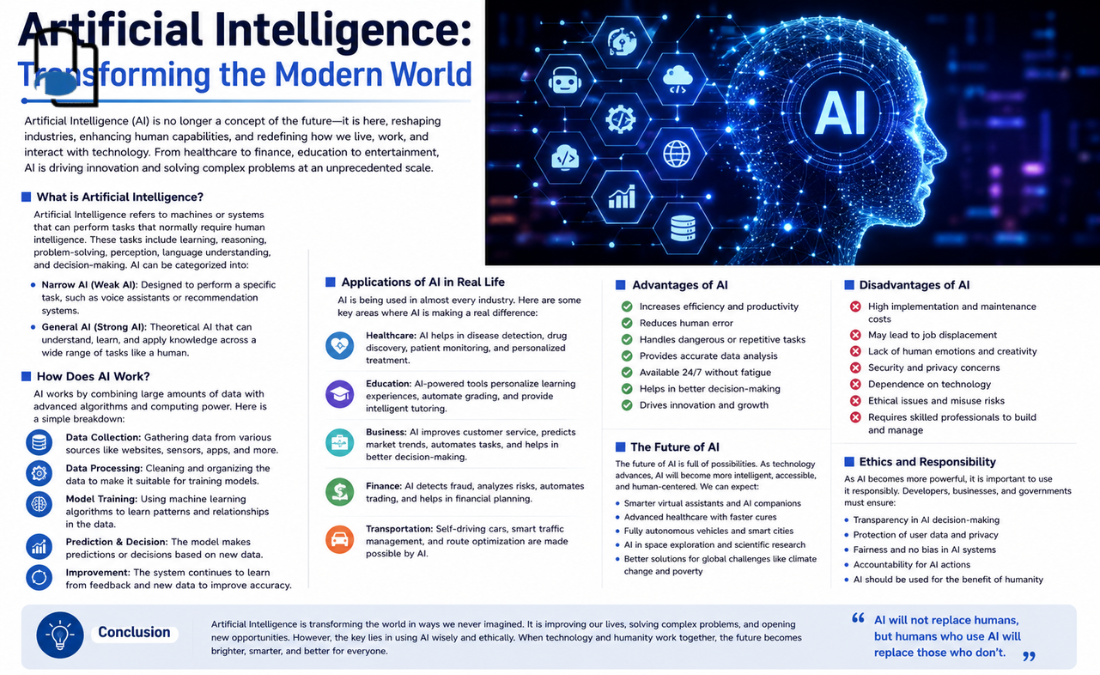
Artificial Intelligence (AI) is one of the most powerful and rapidly growing technologies in the world today. It refers to the ability of machines and computer systems to perform tasks that normally require human intelligence, such as learning, problem-solving, decision-making, and understanding language.
From smartphones to healthcare systems, AI is becoming an essential part of everyday life. It is changing how businesses operate, how people communicate, and even how governments make decisions.
In this article, we will explore what AI is, how it works, its applications, advantages, disadvantages, and its future impact on society.
What is Artificial Intelligence?
Artificial Intelligence is a branch of computer science focused on building smart machines capable of performing tasks that usually require human thinking.
AI systems use data, algorithms, and machine learning techniques to improve their performance over time. Unlike traditional software, AI can learn from experience.
There are two main types of AI:
- Narrow AI: Designed for specific tasks like voice assistants or recommendation systems.
- General AI: A theoretical form of AI that can perform any intellectual task like a human.
How AI Works
AI works by combining large amounts of data with fast, iterative processing and intelligent algorithms.
The main steps include:
- Data Collection: AI systems gather data from different sources.
- Processing: The data is cleaned and organized.
- Training Models: Machine learning models are trained using this data.
- Prediction: The AI system makes predictions or decisions based on patterns.
- Improvement: The system learns from mistakes and improves over time.
Applications of Artificial Intelligence
AI is used in almost every industry today.
1. Healthcare
AI helps doctors diagnose diseases, analyze medical images, and suggest treatments faster and more accurately.
2. Education
AI-powered tools help students learn through personalized lessons and smart tutoring systems.
3. Business
Companies use AI for customer service, marketing, sales prediction, and automation.
4. Transportation
Self-driving cars and smart traffic systems rely heavily on AI technology.
5. Entertainment
Streaming platforms like Netflix and YouTube use AI to recommend content.
Advantages of AI
AI offers many benefits:
- Increases efficiency and productivity
- Reduces human error
- Works 24/7 without breaks
- Helps in complex decision-making
- Automates repetitive tasks
Disadvantages of AI
Despite its benefits, AI also has some drawbacks:
- Job displacement in some industries
- High development and maintenance costs
- Lack of human emotions and creativity
- Security and privacy concerns
- Dependence on technology
Future of Artificial Intelligence
The future of AI is very promising. Experts believe that AI will continue to evolve and become more advanced.
In the coming years, AI may:
- Improve healthcare treatments
- Power smart cities
- Enhance education systems
- Support scientific research
- Create new job opportunities
However, it will also require strict regulations to ensure ethical use.
Conclusion
Artificial Intelligence is transforming the world at an incredible speed. It is making life easier, faster, and more efficient. At the same time, it raises important questions about privacy, ethics, and job security.
The key to a successful future with AI is balance—using it wisely while managing its risks.
FAQs
1. What is Artificial Intelligence?
Artificial Intelligence is the ability of machines to perform tasks that normally require human intelligence.
2. Is AI dangerous for jobs?
AI may replace some jobs, but it also creates new opportunities in technology and data fields.
3. Where is AI used in daily life?
AI is used in smartphones, social media, online shopping, healthcare, and transportation.
4. Can AI think like humans?
Current AI cannot think like humans, but it can mimic certain human behaviors.
5. What is the future of AI?
The future of AI includes smarter systems, automation, and improved human-machine collaboration.