

Introduction
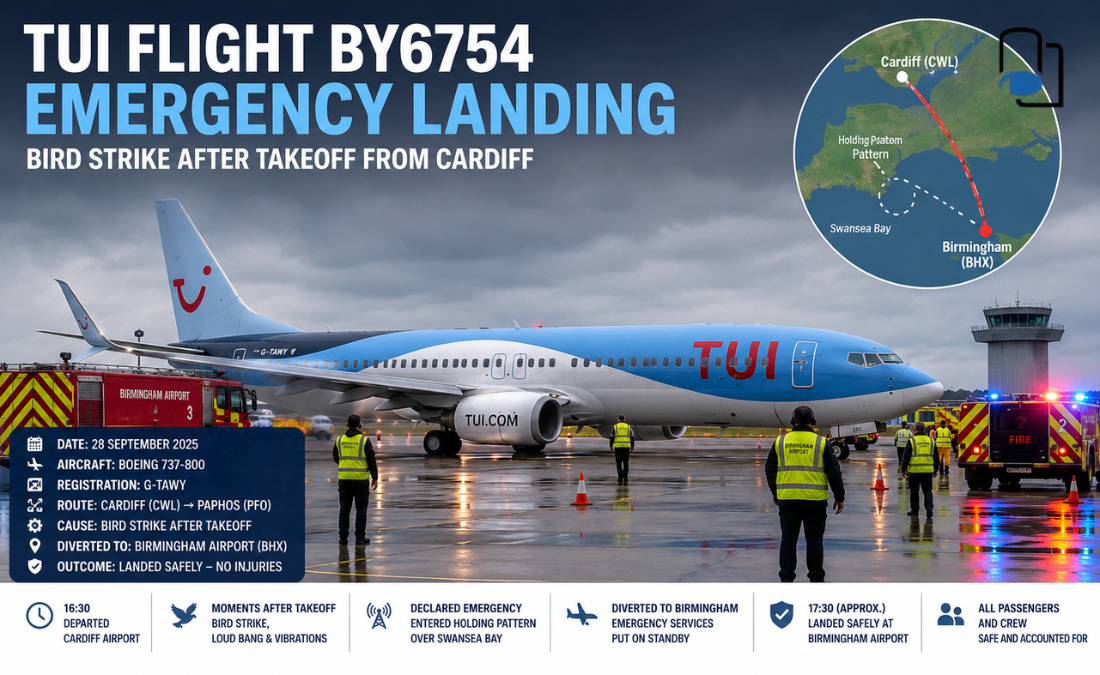
On 28 September 2025, TUI Flight BY6754 Emergency Landing BY6754 became the focus of widespread attention after it was forced to make an emergency diversion shortly after departure from Cardiff Airport in the United Kingdom. The flight, which was scheduled to travel to Paphos in Cyprus, experienced a serious in-flight incident that led to an emergency landing at Birmingham Airport.
Although the situation caused alarm among passengers, the aircraft landed safely, and no injuries were reported. The event was later confirmed to be linked to a bird strike shortly after takeoff. This article provides a complete breakdown of what happened, why the emergency landing occurred, how the crew responded, and what passengers experienced during the incident.
Flight Overview
TUI Flight BY6754 was operated by TUI Airways, a well-known British leisure airline that operates holiday routes across Europe and beyond.
Key Flight Details:
- Airline: TUI Airways
- Flight Number: BY6754
- Aircraft Type: Boeing 737-800
- Departure Airport: Cardiff Airport, Wales (CWL)
- Destination: Paphos International Airport, Cyprus (PFO)
- Date: 28 September 2025
- Outcome: Emergency diversion and safe landing at Birmingham Airport
The aircraft involved was a Boeing 737-800, a widely used short to medium-haul aircraft known for its reliability and safety record.
Timeline of the Incident
Understanding the sequence of events helps clarify how the situation developed so quickly after takeoff.
1. Departure from Cardiff
The flight departed Cardiff Airport in the afternoon under normal operating conditions. Weather conditions were reported to be stable, and there were no initial signs of technical issues before takeoff.
2. Takeoff and Initial Climb
Shortly after liftoff, the aircraft began its climb phase. This is one of the most critical phases of flight, where aircraft are most vulnerable to external hazards such as bird activity.
3. Sudden Impact
Passengers and crew reported hearing a loud bang shortly after takeoff. This was followed by noticeable vibrations on one side of the aircraft. Some passengers also described a faint burning smell inside the cabin, which increased concern on board.
4. Pilot Response
The flight crew immediately followed standard safety procedures. They assessed the situation, declared an emergency, and entered a holding pattern over Swansea Bay while evaluating the condition of the aircraft.
5. Decision to Divert
Due to safety concerns, the pilots decided not to continue the journey to Cyprus. Instead, they diverted the aircraft to Birmingham Airport, which is equipped to handle emergency landings and has full fire and rescue capabilities.
6. Safe Landing
The aircraft landed safely at Birmingham Airport approximately one hour after departure. Emergency response teams were already on standby, but their intervention was not required beyond precautionary observation.
Cause of the Emergency
Initial speculation suggested a possible engine malfunction due to the noise and vibration experienced on board. However, after inspection and airline confirmation, the incident was attributed to a bird strike shortly after takeoff.
What is a Bird Strike?
A bird strike occurs when a bird collides with an aircraft, usually during takeoff or landing. These incidents are relatively common in aviation but can sometimes cause serious damage depending on the size of the bird and the part of the aircraft affected.
In this case:
- The strike occurred shortly after departure
- It likely impacted one of the engines
- The crew detected abnormal vibrations and possible engine disturbance
- A precautionary diversion was immediately initiated
Passenger Experience On Board
Passengers described the incident as unsettling but controlled. The sudden loud noise caused immediate concern, especially among those unfamiliar with aviation procedures.
Reported Passenger Reactions:
- A loud “bang” heard shortly after takeoff
- Brief shaking or vibration on one side of the aircraft
- A faint burning smell in the cabin
- Initial confusion followed by reassurance from the crew
Despite the tension, many passengers praised the professionalism of the cabin crew and pilots. The communication onboard helped reduce panic, and instructions were delivered clearly and calmly.
Some passengers noted that the atmosphere shifted from fear to relief once it became clear that the aircraft was under control and heading for a safe landing.
Emergency Landing at Birmingham Airport
Birmingham Airport was selected as the diversion point due to its proximity and capability to handle emergency situations involving large passenger aircraft.
Airport Response:
- Emergency services were placed on standby
- Runway operations were temporarily adjusted
- Air traffic was coordinated to prioritize the incoming aircraft
The Boeing 737-800 landed without incident. After touchdown, it was inspected by technical teams to assess any damage caused by the bird strike.
No evacuation was required, and passengers remained calm during the landing process.
Aircraft Safety and Technical Assessment
The Boeing 737-800 is designed with multiple safety redundancies. Even in the case of an engine disturbance, the aircraft is capable of flying safely on a single engine if necessary.
Safety Factors in This Incident:
- Dual-engine configuration allowed continued flight after impact
- Pilots followed standard bird strike emergency protocols
- Aircraft systems remained stable during diversion
- No structural damage affecting cabin safety was reported
After landing, engineers typically inspect:
- Engine integrity
- External fuselage damage
- Landing gear condition
- Sensor and system alerts triggered during flight
While detailed inspection results are not publicly confirmed, the safe landing suggests that damage was controlled and manageable.
Why Bird Strikes Are Taken Seriously
Bird strikes are one of the most common aviation hazards worldwide. Although many are minor, they are treated with high seriousness due to the potential risk to engines and flight safety.
Key Risks:
- Engine damage or failure
- Reduced thrust during critical flight phases
- Windshield impact or structural damage
- Loss of system performance in extreme cases
Why Takeoff Is Most Dangerous:
During takeoff:
- Aircraft are low to the ground
- Engines operate at high thrust
- Reaction time for pilots is limited
Because of these factors, even a minor bird strike can lead to precautionary emergency procedures like diversion.
Role of TUI Airways Crew Response
The response from the flight crew was widely considered effective and professional. In aviation emergencies, pilot training plays a critical role in ensuring passenger safety.
Crew Actions:
- Immediate assessment of engine performance
- Declaration of emergency status
- Communication with air traffic control
- Decision-making for safe diversion
- Calm communication with passengers
Cabin crew also played a key role in maintaining order and ensuring passengers remained seated and informed throughout the incident.
Aftermath and Passenger Safety
After landing at Birmingham Airport:
- Passengers were safely disembarked
- Airline staff provided assistance and rebooking options
- Aircraft was taken out of service for inspection
- Flight operations resumed normally after clearance
No injuries were reported, and all passengers were accounted for and safe.
Aviation Safety Perspective
This incident highlights the importance of established aviation safety systems. While emergencies can occur unexpectedly, modern aircraft and trained crews are designed to handle such events efficiently.
Key Takeaways:
- Bird strikes, while common, are usually manageable
- Pilots are trained for rapid emergency decision-making
- Diversion airports are always pre-identified during flight planning
- Passenger safety remains the highest priority in all situations
The safe outcome of Flight BY6754 reinforces the effectiveness of aviation safety protocols in real-world emergencies.
Conclusion
The emergency landing of TUI Flight BY6754 serves as a clear example of how quickly unexpected events can occur in aviation and how effectively they can be managed when proper procedures are followed. A bird strike shortly after takeoff created a potentially dangerous situation, but quick action by the flight crew ensured a safe diversion and landing at Birmingham Airport.
Despite the initial fear experienced by passengers, the incident ended without injuries or serious damage. It stands as a reminder of both the risks present in aviation and the high level of training and safety systems that protect passengers every day.
Frequently Asked Questions (FAQs)
1. What caused the TUI Flight BY6754 emergency landing?
The emergency landing was caused by a bird strike shortly after takeoff from Cardiff Airport, which led the pilots to divert the aircraft as a precaution.
2. Were there any injuries on the flight?
No. All passengers and crew landed safely at Birmingham Airport without any injuries reported.
3. Why was Birmingham Airport chosen for landing?
Birmingham Airport was selected because it was nearby, suitable for emergency landings, and equipped with full emergency response facilities.
4. Did the aircraft suffer serious damage?
Initial reports suggest no catastrophic damage occurred. However, the aircraft was taken for inspection after landing as standard procedure following a bird strike.
5. How common are bird strikes in aviation?
Bird strikes are relatively common worldwide, especially during takeoff and landing, but modern aircraft and safety procedures are designed to handle them safely in most cases.